LED Strip — Addressable
Addressable strip, one IC per LED
Addressable strip gives every LED its own instruction. The run stops being a lamp and becomes a low-resolution screen laid along an edge — which is exactly what stage and sign work ask of it.
ADDRESSABLE STRIP — INDIVIDUAL CONTROL ALONG THE RUN
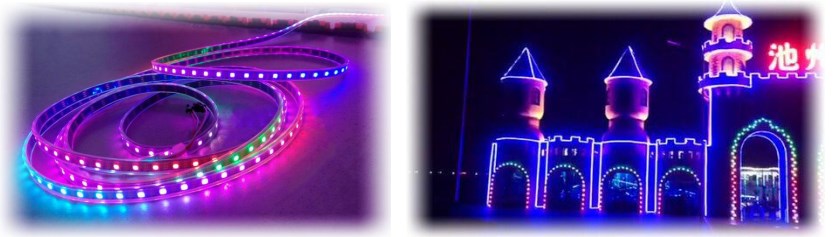
Every LED answering for itself
The published model in this sub-family carries one control chip for each LED, and that ratio is the whole story: colour and brightness are set per lamp, so a chase, a gradient or a sparkle can travel along the run. The model's page publishes its data speed and cutting interval alongside the electrical table — the two figures that decide how fine the effect can be and where the run can be divided.
Buyers arriving from ordinary RGB strip should note the system change. An addressable run is specified as strip plus controller plus power, and the controller is not an accessory afterthought; it is where the effect lives.
- Count the points from the drawing before pricing anything.
- Choose the controller with the strip, never after it.
- Plan the feed points on the drawing, at both ends of long runs.
How addressing changes the wiring
Three practical consequences follow from individual control. First, the run carries data as well as power, so connections and direction matter in a way a steady run never asks about. Second, long runs need power fed at more than one point to stay even. Third, the cutting interval printed on the model page becomes a design unit: shapes and letters are planned in multiples of it.
The installation guide on the blog works through the wiring sequence for pixel runs, and the same discipline — plan the data path, feed the power, seal the ends — applies along an addressable strip.
Before you order
Ask which configuration in this series fits your project — one form covers every line, and the reply quotes against your model, quantity and destination.