Guide
Amusement park lighting guide
A park is not a big ride. It is twenty structures with one electrical crew, and its lighting succeeds as a system — specified together, maintained together, and dark in the smallest possible pieces when something fails.
GUIDE — THE PARK AS ONE SYSTEM OF SMALL STRUCTURES
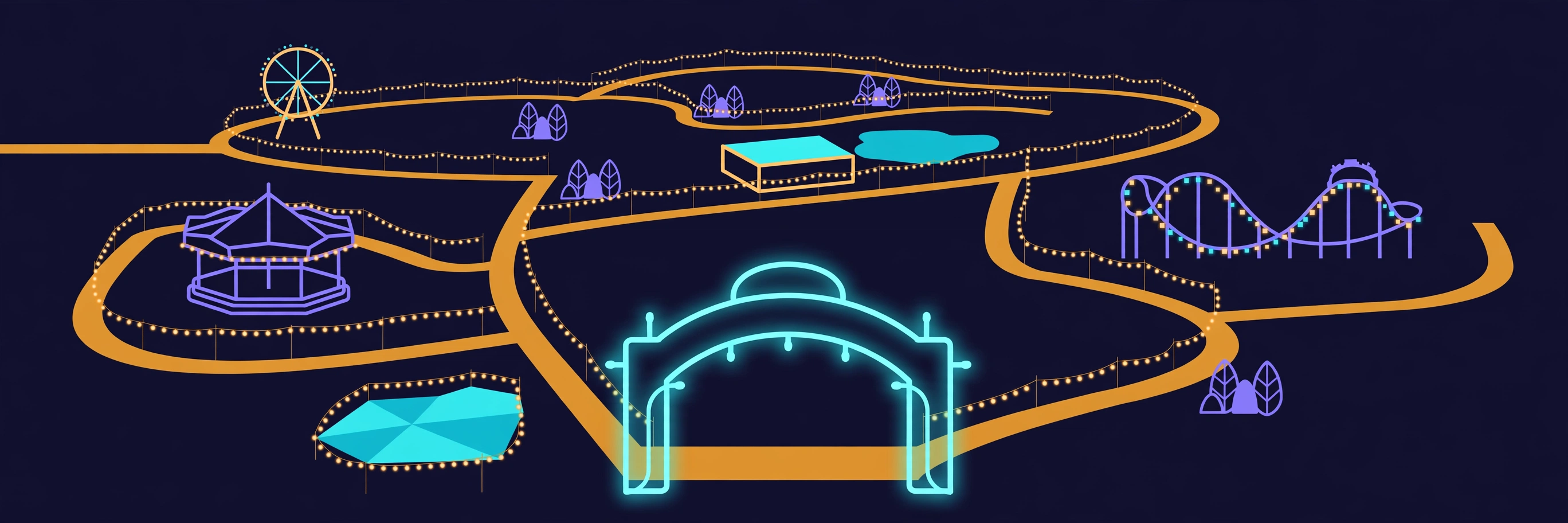
Planning light for a whole park
| Park element | First line to consider | Planning note |
|---|---|---|
| Signature ride | Programmable pixel strings | The designed effect earns its control system here |
| Carousel and rotating rides | Pre-programmed pixels | Power-only wiring suits moving structures |
| Ferris wheel | Single-colour pixel bulbs | Screw-base spares suit rim maintenance |
| Entrance and signage | Neon flex + strings | Letters in neon; boards backlit or outlined |
| Paths and fences | String lights | Festoon runs double as wayfinding |
| Stages and event lawns | Floods + strip | Washes and scenic edges, struck after events |
Sequencing matters more than selection. Light the entrance and the signature ride first — they carry the park's photograph — then the paths that make the lit structures reachable, then the secondary rides. A park that opens with its icons lit and its paths safe can grow; a park that spread the same budget evenly opens dim everywhere.
Budget the unglamorous lines with the same care as the icons. Power distribution, control placement and the spares shelf are what the second season feels; a park that spent everything on lamps discovers in year two that its lighting is a collection of structures waiting for parts. A working rule is to let the infrastructure lines of the quotation — supplies, controllers, cable, spares — be argued about as seriously as the lamp lines, and to treat any quotation where they are suspiciously small as a quotation for opening night only.
Phasing is the other budget tool. A park lit in two phases — icons and paths first, secondary structures a season later — buys its second phase with operating revenue and, just as valuable, with a season of failure data: which seals weathered, which runs the crew can service fastest, which effects the guests photograph. Phase two specified from that evidence is a better purchase than phase two specified from the same brochure as phase one.
One discipline holds the phases together: a single park-wide record of what was installed where — model, colour, voltage, feed point, controller — kept current as structures are added. Parks grow by accretion, and accretion without records produces the familiar archaeology of unlabeled cabinets and mystery cables. The record is a page long per structure and is the cheapest item in this entire guide; it is also the one whose absence is most expensive, because every later decision in this article depends on knowing what the park already owns.
Pairing lines across one park
Every control philosophy in the park is a maintenance commitment, so pair lines to keep the count low: one programmable system for the designed features, self-running pixels everywhere rotation or distance makes control expensive, and steady colour where the structure is read from far away. Power follows the same logic — supplies placed per structure, so a failure darkens one feature and the crew's round stays short.
The applications page maps each structure type to its line, and the choosing guide's checklist scales from one structure to twenty without changing its questions. Bring both to the inquiry, with the park plan: a quotation against a plan is a system; a quotation against a lamp count is a pallet.
Before you order
Put your project details in the inquiry and get a matched recommendation — one form covers every line, and the reply quotes against your model, quantity and destination.