Blog
LED strip lights for stage decoration
Look at any stage photograph that works and it separates, on inspection, into three jobs of light. A colour field covers the backdrop and sets the mood. Lines — along truss edges, scenic frames and stair nosings — draw the architecture. Points and festoons add the sparkle the audience reads as occasion. Strip, floods and strings divide those jobs between them almost exactly, and a decoration plan that starts from the three jobs, rather than from a product list, tends to buy the right things once.
BLOG — ONE STAGE PICTURE, THREE LIGHT LINES
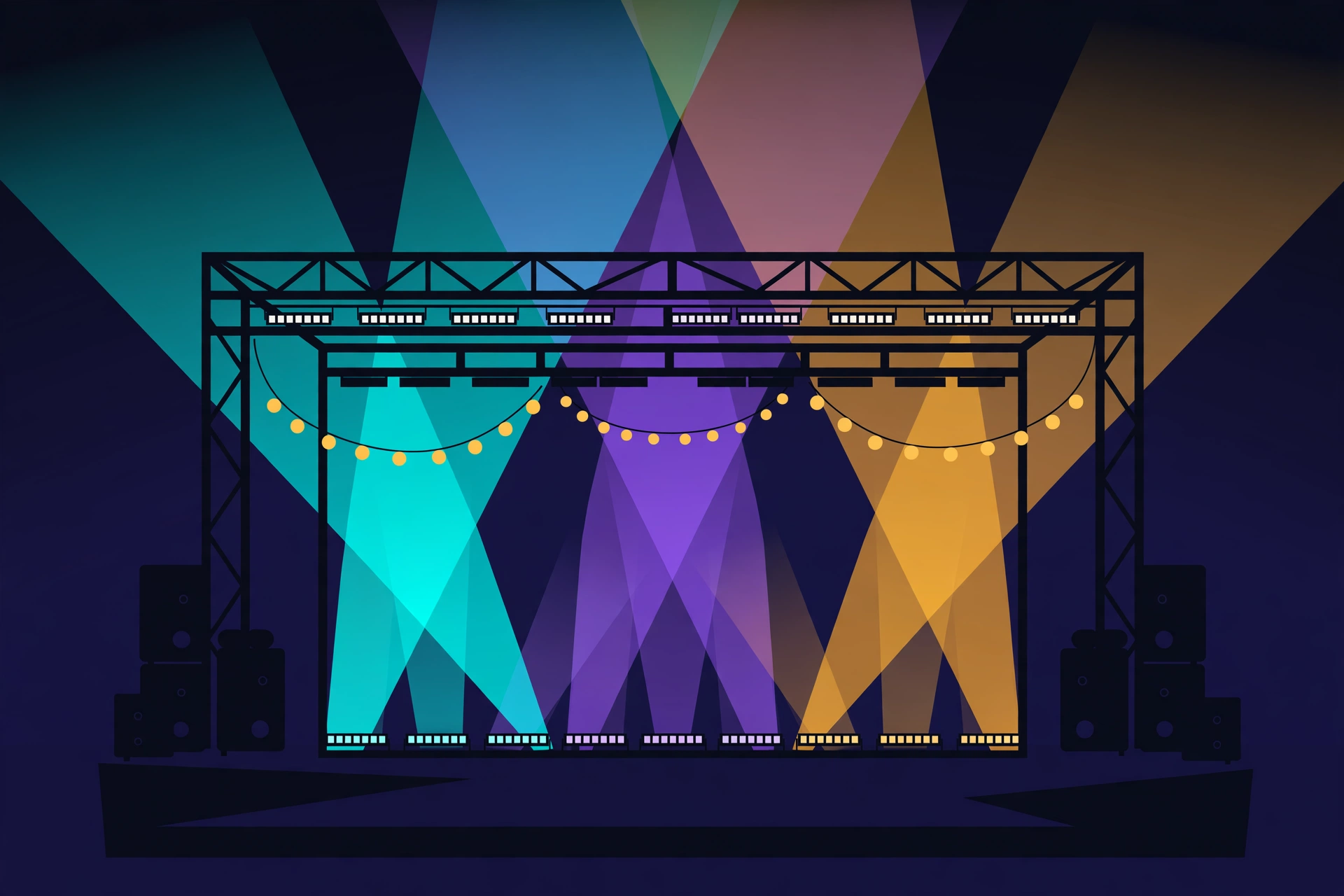
The stage picture divides into three jobs
This article builds one picture in that order: a mid-size venue stage, a backdrop that must change colour between acts, scenic flats with edges worth drawing, and an entrance arch the audience passes under. Every component in the example comes from the lines above, and every choice is made for a reason that can be argued with.
Job one: the field, and job two: the lines
The backdrop takes floods. A row of colour floods along its base — the catalogue's published flood model is the costing anchor — washes the cloth evenly and recolours it per act from its remote. Floods earn this job because coverage is their whole design: one fixture, one wide field, and a set of them read as one surface of colour when their spacing is honest.
The lines take strip, and specifically addressable strip along the scenic edges. A chase travelling around a flat's frame does theatrical work no wash can do: it moves, and movement is what tells an audience where to look. The published SK6812 model's page — one chip per LED, a stated cutting interval — is where the edge runs are costed from, with the cutting interval treated as the design unit the flats are drawn in. Power for those runs is fed at the flats' bases, planned on the drawing, because a dense addressable edge is the hungriest light in the building per metre.
Counting the floods for a backdrop is a throw problem before it is a brightness problem. Stand where the fixture row will sit, measure to the top of the cloth, and space the fixtures so their washes overlap at that distance — evenness at the top edge is what the audience reads as quality, and it is set by spacing, not by wattage. A row spaced for the bottom of the cloth blooms there and starves at the top; a row aimed and spaced for the top edge covers the whole field with the same fixtures. Count from the overlap, then add the one spare the lessons at the end of this article insist on.
Job three: points, festoons and the arch
The arch and the ceiling take strings. Festoon strings over an entrance do the oldest trick in venue decoration — they lower the sky and warm it — and the string model this catalogue publishes is a programmable one, so the festoon can idle in a warm sequence and join the show when the room becomes part of the act. Its connector system matters here: an arch is serviced from a ladder, in sections, and joins that open by hand are the difference between a February fix and a February scaffold.
Notice what the three jobs share: each line was chosen for the geometry of its task, and each is costed from its model page or its family page. The stage line's own page lays the same division out as a table for buyers who arrive with a venue instead of a photograph.
Colour discipline across three systems
| Element of the picture | Line that carries it | Pairing note |
|---|---|---|
| Backdrop colour field | Flood lights | Costed as a set from the F720-200W page |
| Scenic edges and frames | Addressable strip | Cutting interval becomes the design unit |
| Entrance arch and ceiling | Programmable strings | Sections join and service by hand |
| Steady architectural lines | Single-colour strip or bulbs | Chosen where the picture must not move |
Three systems rendering one design colour is the quiet risk in the whole picture. Nominal colour is a label, not a measurement, and two product families can honour the label while disagreeing visibly on a backdrop. The defence is procedural: specify the systems together, note the design colour in the inquiry for every line, and, where the venue allows it, see samples from each family lit side by side before the full order. A five-minute comparison in a dark room has saved more openings than any amount of specification prose.
Run the comparison under the venue's own dimming, too. Two systems that agree at full brightness can part company at half: dimming curves differ, and a backdrop that matches its scenic edges at full glow may drift from them in the quiet scene, which is precisely the scene the audience watches longest. Check the match at the levels the show actually uses, and note the settings where the three systems agree — that note belongs in the show file, next to the cue list.
Strike and storage: the fourth job
Stage decoration is the only lighting in this catalogue designed to be removed. That makes storage a design input: strip runs that will be struck should be planned in lengths that coil and label well; strings should come down in their sections with connectors protected; floods should travel in their cases rather than their cartons. A decoration system that survives its third strike is one whose load-out was imagined at purchase, and the inquiry is the moment to say the quiet part aloud — this rig tours, or this rig is struck twice a year — because the answers change small, cheap details: connector choices, section lengths, the spares list.
Label at strike, not at load-in. The crew striking a show is tired and hurried; the crew loading in is fresh and grateful for every tag. A section marked with its flat, its orientation and its feed direction turns the next load-in from archaeology into assembly.
Load-in lessons
Two practical notes close the example. First, control: the floods, the addressable edges and the programmable strings can share a show's logic only if their control is specified together, in one inquiry, with the venue's desk in mind — three separately bought systems will meet for the first time at load-in, which is the most expensive introduction in theatre. Second, spares: a strip section, a string section and one flood, held at the venue, cover the realistic failures of a run. Decoration that cannot be repaired between shows is not decoration; it is a countdown.
Before you order
Sourcing light lines like these? Talk to the sales team — one form covers every line, and the reply quotes against your model, quantity and destination.